
Information compiled based on industry standards and publicly available technical references.
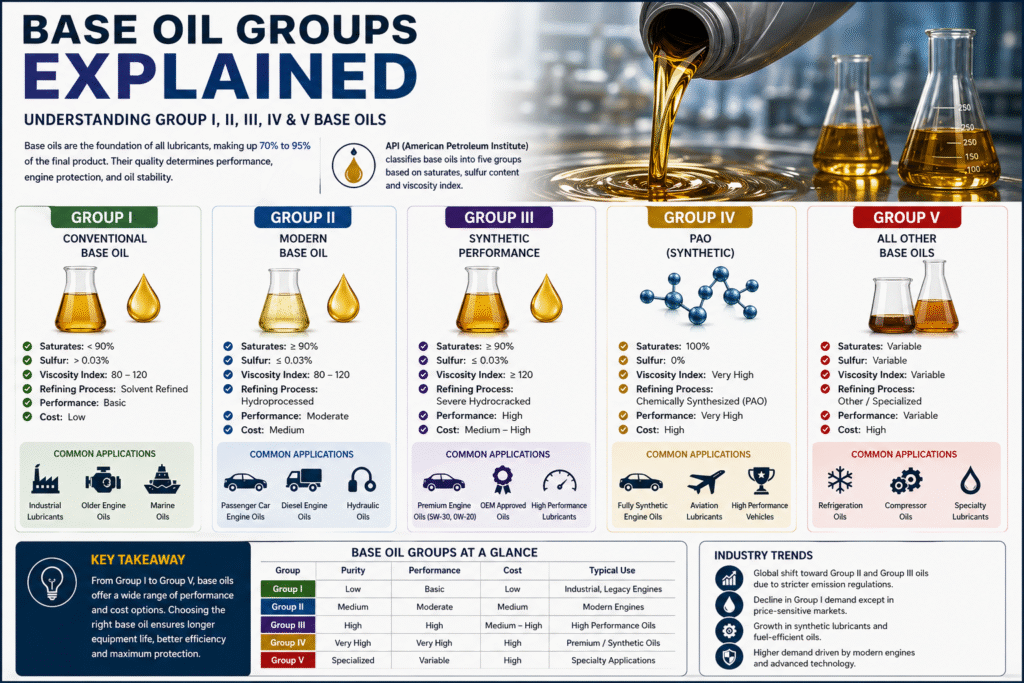
Introduction to Base Oil Groups
Base oils are the foundation of all lubricants, making up 70% to 95% of the final product. The quality of base oil directly impacts engine performance, equipment life, and oil stability.
To standardize classification, the American Petroleum Institute (API) categorizes base oils into five main groups: Group I, Group II, Group III, Group IV, and Group V based on:
- Saturates content
- Sulfur content
- Viscosity Index (VI)
Understanding these groups is essential for selecting the right lubricant for automotive, industrial, and commercial applications.
What Are API Base Oil Groups? (Quick Overview)
| Base Oil Group | Purity Level | Viscosity Index | Sulfur Content | Key Feature |
|---|---|---|---|---|
| Group I | Low | 80–120 | High | Cost-effective |
| Group II | Medium | 80–120 | Low | Cleaner & stable |
| Group III | High | ≥120 | Very low | Synthetic-grade |
| Group IV | Very High | Very high | None | True synthetic (PAO) |
| Group V | Specialized | Variable | Variable | Performance additives |
Group I Base Oil – (Conventional Base Oil)
What is Group I Oil?
Group I base oils are produced using solvent refining, making them the oldest and most traditional type of base oil.
Key Characteristics
- Saturates: Less than 90%
- Sulfur: Greater than 0.03%
- Moderate viscosity index
- Contains aromatic compounds
Advantages
- Low cost and widely available
- Good solvency (better additive mixing)
Disadvantages
- Lower oxidation stability
- Shorter oil life
- Poor performance in extreme temperatures
Common Applications
- Industrial lubricants
- Older engine oils
- Marine oils
Group II Base Oil – Modern Standard
What is Group II Oil?
Group II oils are produced through hydrocracking and hydrotreating, resulting in cleaner and more refined base oil.
Key Characteristics
- Saturates ≥90%
- Sulfur ≤0.03%
- Improved thermal stability
Advantages
- Better engine cleanliness
- Longer oil life than Group I
- High oxidation resistance
Disadvantages
- Slightly higher cost than Group I
- Lower solvency
Common Applications
- Passenger car engine oils
- Diesel engine oils
- Hydraulic oils
Group III Base Oil – Synthetic Performance
What is Group III Oil?
Group III oils are severely hydrocracked, making them extremely pure and high-performing. In many markets, they are marketed as synthetic oils.
Key Characteristics
- High viscosity index (≥120)
- Very low sulfur
- Excellent oxidation resistance
Advantages
- Superior performance at high temperatures
- Improved fuel efficiency
- Longer drain intervals
Disadvantages
- Higher cost
- Requires additives for solvency
Common Applications
- 5W-30, 0W-20 engine oils
- Premium automotive lubricants
- OEM-approved oils
Group IV Base Oil – True Synthetic (PAO)
What is Group IV Oil?
Group IV base oils are polyalphaolefins (PAO), chemically synthesized for maximum performance.
Key Characteristics
- Uniform molecular structure
- Excellent low-temperature flow
- Very high viscosity index
Advantages
- Outstanding thermal stability
- Long service life
- Excellent performance in extreme conditions
Disadvantages
- Expensive
- Requires ester blending for additive compatibility
Common Applications
- Fully synthetic engine oils
- Aviation lubricants
- High-performance vehicles
Group V Base Oil – Specialty Oils
What is Group V Oil?
Group V includes all other base oils such as:
- Esters
- PAG (Polyalkylene Glycol)
- Naphthenic oils
Key Characteristics
- Application-specific
- Often used as additives or blending components
Advantages
- Excellent lubricity
- High temperature stability
- Enhanced performance when blended
Disadvantages
- High cost
- Limited standalone use
Common Applications
- Refrigeration oils
- Compressor oils
- Specialty lubricants
Difference Between Group I, II, III, IV & V (Quick Comparison)
| Feature | Group I | Group II | Group III | Group IV | Group V |
|---|---|---|---|---|---|
| Refining | Solvent | Hydroprocessed | Severe Hydrocrack | Synthetic | Specialty |
| Performance | Basic | Moderate | High | Very High | Variable |
| Cost | Low | Medium | Medium-High | High | High |
| Usage | Industrial | Automotive | Premium oils | Synthetic oils | Additives |
Market Trends in Base Oils (2026 and Beyond)
- Increasing shift toward Group II and Group III oils globally
- Decline in Group I demand (except developing markets)
- Growth in synthetic lubricants and fuel-efficient oils
- Higher demand driven by modern engines and emission standards
Conclusion – Which Base Oil Group is Best?
There is no “one-size-fits-all” answer:
- Group I → Budget and industrial use
- Group II → Standard modern lubricants
- Group III → High-performance and synthetic-grade oils
- Group IV & V → Premium and specialized applications
Choosing the right base oil depends on performance requirements, cost, and application type.
