
Author / Research: Ehsan Ahmed Taj
Sector: Fuel, Energy & Lubricants
Published: January 2026
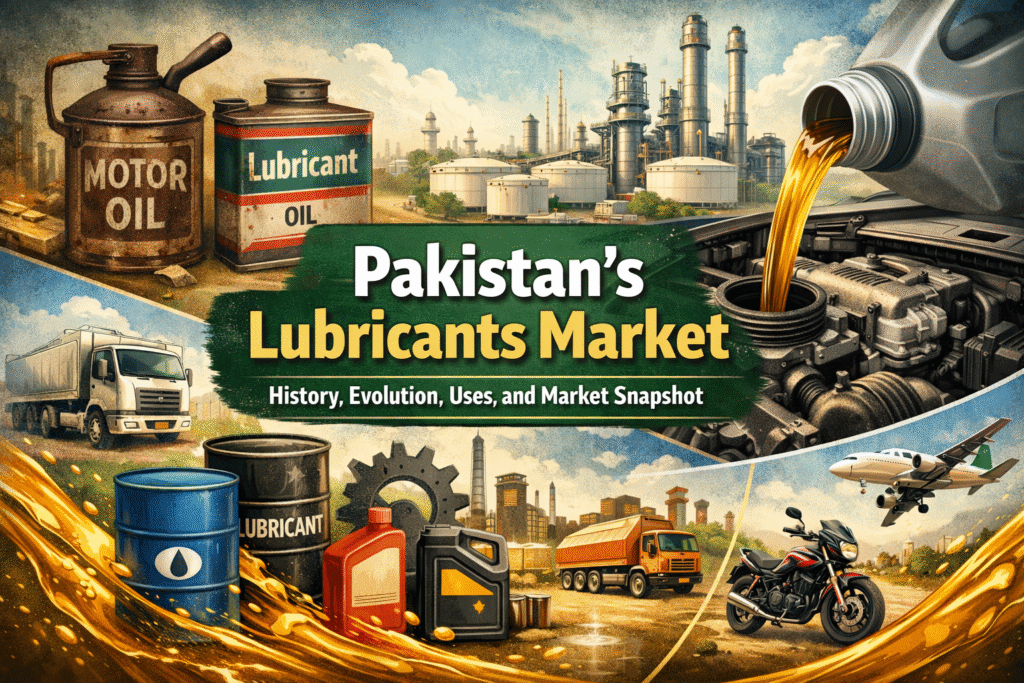
Disclaimer:
This image is an AI-generated illustration created for editorial and informational purposes only. It does not represent any specific brand, company, or trademark, nor does it imply endorsement or affiliation with any entity.
Lubricants are one of those quiet everyday heroes: you never see them, but without them engines don’t run, factories don’t spin, and economies slow down. In Pakistan the lubricants industry has moved from a simple trade in mineral-based engine oils to a diverse market of synthetic blends, specialty fluids and value-added services — driven by rising vehicle ownership, industrialization, and infrastructure projects. This article traces that evolution, explains why lubricants matter, and gives a clear picture of the current market — numbers, players, and near-term trends.
A short history — how Pakistan’s lubricant market evolved
The lubricants story in Pakistan follows the arc of the country’s industrial and transport development.
- Early decades (1950s–1970s): As the automobile and agricultural sectors grew after independence, basic mineral oils imported or produced locally were the dominant product. International oil majors established supply and retail footprints (brand-name service stations and branded lubricants) to serve rising demand. Shell and other global players introduced branded motor oils and service programs in this era. (Shell Pakistan)
- Growth and localization (1980s–2000s): Domestic blending and packaging capacity expanded. Local companies (and the lubricants divisions of Oil Marketing Companies — OMCs such as PSO) increased market share, while multinational brands continued to serve premium segments. The market diversified into passenger-car engine oils, commercial-vehicle oils, industrial oils (hydraulic, gear, turbine), and two-wheeler oils.
- Modern phase (2010s–today): Demand drivers shifted: motorcycle and passenger-car ownership rose significantly; industrial projects (including CPEC-linked construction and power projects) increased demand for industrial lubricants; and fleet/logistics growth created steady diesel-engine oil demand. At the same time, formulation technology moved toward synthetic and semi-synthetic oils, and service offerings evolved to include technical support, condition monitoring and lubricant management. Recent corporate moves (e.g., sales and restructuring among international players operating in Pakistan) reflect the changing economics and strategic focus of global majors. (Reuters)
What lubricants do — the technical and economic importance
Lubricants perform essential functions across engines and machines. The key roles are:
- Reduce friction and wear. A thin film of oil separates moving metal surfaces and prevents direct contact that causes abrasion and component failure. (TotalEnergies Marketing Kenya)
- Cool and carry heat away. Oil absorbs heat from pistons and bearings and helps prevent overheating.
- Clean and disperse contaminants. Additives in lubricants carry soot, combustion by-products and small particles away from critical surfaces to filtration systems.
- Corrosion protection. Oil films and additives protect metal parts from moisture and acidic compounds.
- Seal and transfer power. In some systems (e.g., piston rings), oil helps seal gaps; hydraulic fluids transmit power.
- Extend service intervals and reduce downtime. Better lubrication reduces the frequency of repairs and replacements — a direct cost saving for fleets and industries. (Interflon)
Economically, the right lubricant program reduces total cost of ownership: lower fuel and oil consumption, fewer breakdowns, longer machine life, and lower inventory and repair costs. For commercial fleets and industries, those savings compound into significant competitive advantage.
Market size, consumption and structure
While different market reports vary in exact figures, the consistent picture is steady low-single-digit growth and a market measured in hundreds of millions of litres and multiple hundreds of millions of USD annually:
- Volume estimates: Market analyses estimate Pakistan’s lubricants consumption roughly between ~160–400 million litres annually depending on how automotive vs industrial segments are counted and the data source; many recent reports cluster around ~160–200 million litres (2024–2025 baseline) for the lubricants market. (Mordor Intelligence)
- Value estimates & growth: Market value estimates differ by source and scope. One analyst puts the market at about USD 2.28 billion (2024) with a projected CAGR of ~3% out to the early 2030s; other volume-centered reports forecast steady low-single-digit growth to 2030. That growth is driven by vehicle growth, industrial activity and infrastructure projects. (Verified Market Research)
- Who sells lubricants: Major players include global majors (Chevron, ExxonMobil, Shell historically), Pakistan State Oil (PSO) and specialized local blenders such as Hi-Tech Lubricants (HTL), Oilboy and packaging/blending operations that supply both retail and industrial buyers. OMCs remain strong because they pair fuels and lubricants across retail networks and bulk sales. Market share shifts year-to-year; PSO has been reported to hold double-digit market share gains in recent years. (Mordor Intelligence)
(Note: market reports use different methodologies — some include marine and industrial fluids, some separate automotive passenger vs two-wheel vs commercial — so quoted volumes and dollars should be cited against the specific report you choose when publishing.)
Usage patterns — where lubricants are consumed
- Automotive: Passenger cars, motorcycles and commercial vehicles (trucks, buses) form the largest single segment by volume in many estimates — particularly engine oils and gear oils. Two-wheelers are a major consumer segment in Pakistan due to broad motorcycle ownership. (Aurora)
- Industrial & construction: Hydraulic oils, gear oils, compressor oils, turbine oils and greases used in power plants, manufacturing, construction, and CPEC-related infrastructure are a meaningful and growing slice of demand.
- Power generation & marine: Specialized fluids for power plants, generators, and marine engines represent a smaller but high-value segment.
Recent trends & market dynamics
- Shift toward higher-performance formulations. Semi-synthetic and full-synthetic oils, plus specialized industrial formulations, are gaining share as customers seek longer drain intervals and better protection.
- Price sensitivity and inflationary pressure. Global oil price moves, exchange-rate swings and supply chain costs have pushed lubricant prices upward periodically; these macro forces influence margins and consumer behaviour. Local price spikes have caused public debates about retailer concentration and pricing. (Profit by Pakistan Today)
- Consolidation & ownership changes. Global majors have restructured or changed holdings in Pakistan (transactions and strategic exits/entries), affecting brand portfolios in the local market. That can change distribution footprints and the competitive landscape. (Reuters)
- Value-added services. Lubricant suppliers are differentiating with services: oil analysis programs, lubricant management contracts, and bundled fuel+lubricant offerings for fleets.
Challenges & opportunities
- Challenges: Exchange-rate volatility (imports of base oils/additives), regulatory complexity, counterfeit/fake products in informal channels, and price sensitivity among retail buyers.
- Opportunities: Fleet management programs for large transport/logistics customers; industrial demand from infrastructure and energy projects; premiumization to semi-synthetic/synthetic oils; and technical services (oil analysis, filter programs) that lock in customers and raise margins.
Practical takeaways for buyers and fleet managers
- Choose lubricants based on OEM recommendations and operating conditions (heat, dust, load).
- Consider condition monitoring (oil analysis) to optimize drain intervals and detect problems early.
- For fleets, negotiate volume contracts that bundle fuel and lubricant supply and include technical support.
- Beware of low-cost counterfeit oils — buy from reputable distributors or OMC outlets to ensure quality.
Outlook — where the market is headed
Pakistan’s lubricants market is expected to continue growing at a modest single-digit CAGR driven by vehicle parc growth, infrastructure projects, and rising industrial activity. The winners will be companies that combine reliable supply and distribution with technical services and premium formulations — converting commodity buyers into long-term customers.
Sources & further reading
- Mordor Intelligence — Pakistan Lubricants Market (market size, segments). (Mordor Intelligence)
- IndustryARC / Verified Market Research — Market valuation and CAGR projections. (Industry Arc)
- Dawn / industry commentary — consumption estimates and industry context. (Aurora)
- Profit (Pakistan Today) — domestic price dynamics and consumption figures. (Profit by Pakistan Today)
- Reuters — recent corporate transactions affecting lubricants and retail footprints in Pakistan. (Reuters)
Copyright & Rights Notice
© 2026 FUEL & LUBE. All rights reserved.
This article is published for informational and industry analysis purposes only. Reproduction or redistribution without prior written permission of the publisher is prohibited.
