
Author / Research: Ehsan Ahmed Taj
Sector: Fuel, Energy & Lubricants
Published: January 2026
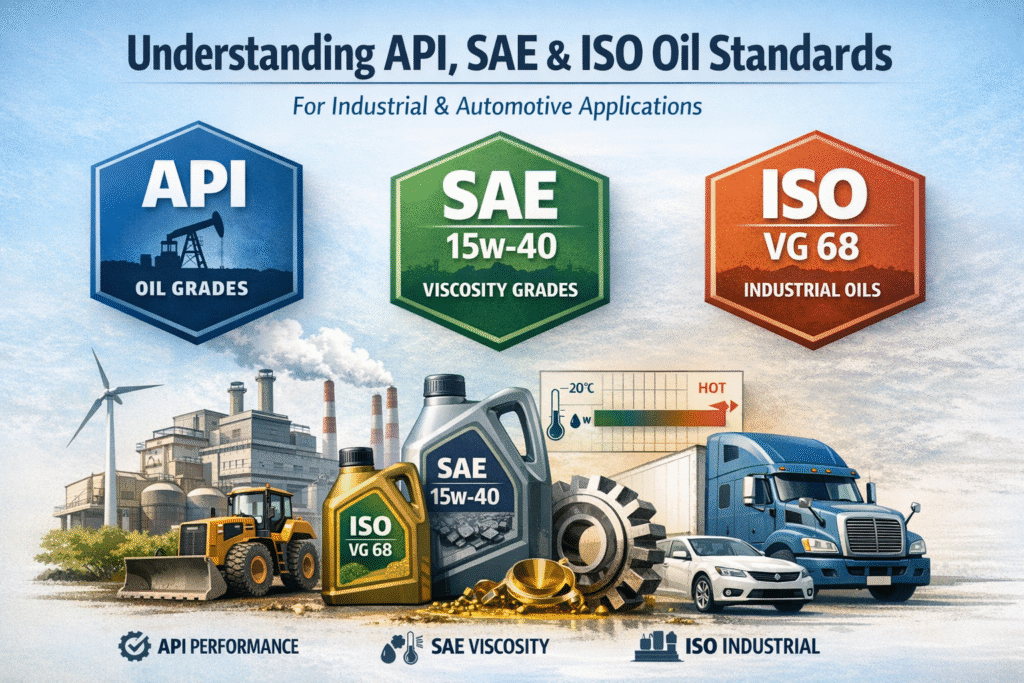
Disclaimer: The information and image provided are for general informational purposes only. Fuel & Lube Pvt Ltd makes no guarantees regarding the suitability of any product for a specific application. Readers should consult qualified engineers and follow manufacturer recommendations before selecting or using lubricants. Fuel & Lube Pvt Ltd is not responsible for any losses or damages resulting from the use of this content. All referenced standards and trademarks (API, SAE, ISO) are the property of their respective owners.
Understanding API, SAE & ISO Oil Standards for Industrial & Automotive Applications
Choosing the correct lubricant is not just a matter of brand or price — it is a technical decision that directly affects equipment performance, maintenance cost, and operational reliability. To help buyers, engineers, and maintenance teams make informed decisions, global oil standards have been developed to classify lubricants based on performance, viscosity, and application suitability.
The three most widely used systems are API, SAE, and ISO. Understanding how these standards work — and how they differ — is essential for selecting the right oil for both industrial machinery and automotive engines.
Why Oil Standards Matter
Lubricants operate under extreme conditions of pressure, temperature, and contamination. If the oil does not meet the required standard, the result can be:
- Increased wear on critical components
- Reduced fuel efficiency
- Higher maintenance and downtime costs
- Shortened equipment lifespan
Standards provide a common technical language between manufacturers, suppliers, and end-users, ensuring the lubricant will perform as expected in specific operating conditions.
1- API Oil Grades — Performance Classification
The American Petroleum Institute (API) classification system defines oil performance based on engine type and service conditions. API grades focus on additive quality, engine protection, and emission system compatibility.
API Categories
🟦 For Gasoline Engines (S Series)
These grades begin with the letter “S” (Service or Spark Ignition):
- API SN, SP, SM, SL
Higher letters generally indicate newer performance standards with better protection against deposits, oxidation, and wear.
🟥 For Diesel Engines (C Series)
These grades begin with the letter “C” (Commercial or Compression Ignition):
- API CI-4, CJ-4, CK-4, FA-4
These oils are designed to handle higher loads, soot levels, and extended drain intervals common in heavy-duty engines.
What API Grades Tell You
API classifications indicate:
- Detergency and cleanliness performance
- Wear and corrosion protection
- Compatibility with emission control systems
- Oxidation and thermal stability
Where API Standards Are Used
Passenger cars and light vehicles
Heavy-duty trucks and buses
Generators and diesel engines
Industrial engine-driven equipment
2- SAE Viscosity Grades — Oil Thickness & Flow
The Society of Automotive Engineers (SAE) system classifies oils based on viscosity, or how thick or thin the oil is at different temperatures.
Understanding the SAE Code
Example: SAE 15W-40
- 15W = Cold temperature performance (“W” stands for Winter)
- 40 = High-temperature operating viscosity
This means the oil flows well in cold conditions and remains thick enough to protect the engine at high operating temperatures.
Common SAE Grades
- 0W-20, 5W-30 — Modern passenger vehicles
- 10W-30, 15W-40 — Commercial and diesel engines
- 20W-50 — Older engines and high-temperature environments
Why Viscosity Matters
Incorrect viscosity can lead to:
- Poor cold starts and increased wear
- Oil film breakdown at high temperatures
- Reduced fuel efficiency
Applications
SAE standards are mainly used for:
- Automotive engines
- Commercial vehicles
- Diesel generators
- Mobile equipment
3- ISO Viscosity Grades — Industrial Oil Classification
The International Organization for Standardization (ISO) uses the ISO VG (Viscosity Grade) system, which is widely applied in industrial lubricants.
How ISO VG Works
ISO grades are based on the oil’s viscosity at 40°C, measured in centistokes (cSt).
Common ISO Grades
- ISO VG 32 — Light hydraulic systems, cold environments
- ISO VG 46 — General-purpose hydraulics and machinery
- ISO VG 68 — Heavy-duty industrial systems, hot conditions
- ISO VG 100 & 150 — Gearboxes and high-load equipment
Where ISO Standards Are Used
- Hydraulic systems
- Industrial gearboxes
- Compressors
- Turbines
- Manufacturing machinery
API vs SAE vs ISO — Key Differences
| Standard | Focus | Measures | Common Applications |
|---|---|---|---|
| API | Performance & quality | Additives, engine protection, emission compatibility | Engines, generators, vehicles |
| SAE | Viscosity | Oil thickness at cold & hot temperatures | Automotive & diesel engines |
| ISO | Viscosity | Oil thickness at 40°C | Industrial machinery & hydraulics |
Choosing the Right Standard for Your Equipment
Automotive & Diesel Engines
Use a combination of API + SAE
Example:
API CK-4, SAE 15W-40
This tells you:
- The oil meets heavy-duty diesel performance standards (API)
- The viscosity is suitable for both cold starts and high operating temperatures (SAE)
Industrial Machinery
Use ISO VG classification
Example:
ISO VG 68 Hydraulic Oil
This ensures the oil has the correct thickness for pumps, valves, and system pressure levels.
Common Selection Mistakes to Avoid
- Using engine oil in hydraulic systems
- Selecting viscosity without considering ambient temperature
- Ignoring OEM recommendations
- Mixing oils with different additive technologies
These errors can cause seal damage, system inefficiency, and premature equipment failure.
Role of Technical Support in Oil Selection
Industrial operations often involve mixed equipment — engines, hydraulics, compressors, and gear systems — each requiring different oil standards. A professional supplier should provide:
- Equipment-based oil mapping
- Lubrication charts
- Oil analysis programs
- Technical documentation and compliance reports
Fuel & Lube Pvt Ltd — Technical Partner for Industry
Fuel & Lube Pvt Ltd supports industrial and commercial clients with standard-compliant lubricants and technical consultation for automotive, textile, power generation, manufacturing, and fleet operations across Pakistan.
Our team assists in:
- Selecting correct API, SAE, and ISO grades
- Developing site-specific lubrication programs
- Ensuring regulatory and OEM compliance
- Reducing downtime and maintenance costs
Need Help Choosing the Right Oil?
📞 Talk to Fuel & Lube’s Technical Support Team
Get expert guidance for selecting the correct lubricant based on your equipment, operating conditions, and compliance requirements.
Copyright & Rights Notice
© 2026 FUEL & LUBE. All rights reserved.
This article is published for informational and industry analysis purposes only. Reproduction or redistribution without prior written permission of the publisher is prohibited.
