
Author / Research: Ehsan Ahmed Taj
Sector: Fuel, Energy & Lubricants
Published: February 2026
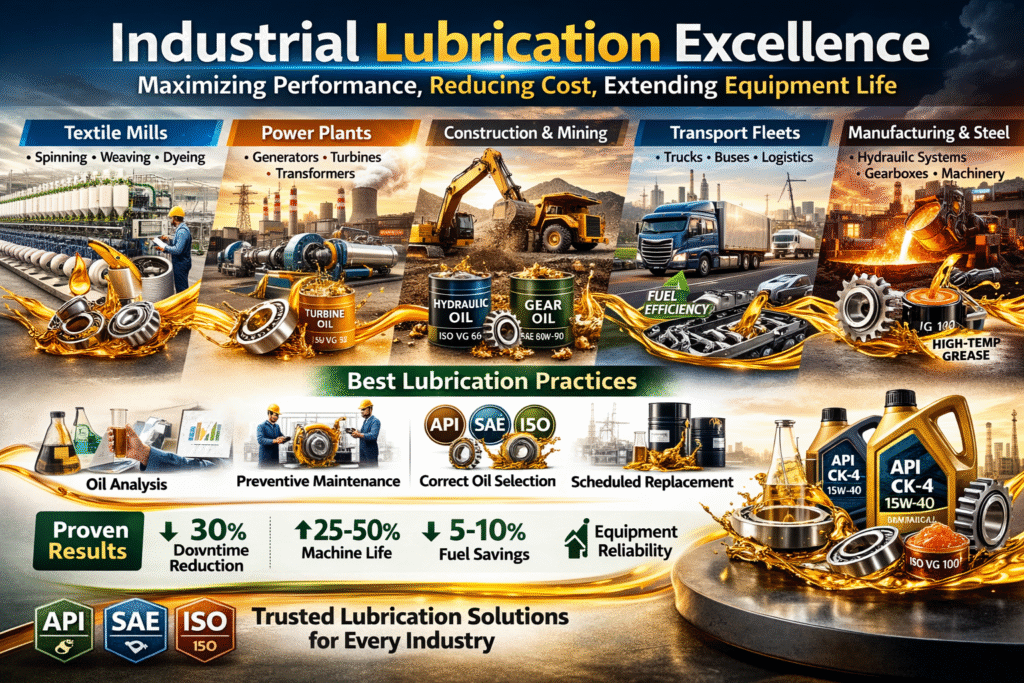
Disclaimer: The images shown are for illustrative and promotional purposes only and represent conceptual industrial lubrication applications across various sectors. Any product grades, specifications, performance figures, or operational scenarios displayed are general industry examples and may vary depending on equipment type, operating conditions, and manufacturer recommendations. These visuals do not represent any specific client, facility, or confirmed performance results, and actual product appearance and specifications may differ.
Why Proper Lubrication Matters for Machinery, Efficiency, and Cost Savings
In modern industry, effective lubrication is more than just adding oil — it’s a critical maintenance strategy that directly impacts equipment life, energy efficiency, downtime, and operating cost. According to industry research, improper lubrication accounts for up to 30% of bearing failures and significantly increases wear, fuel usage, and equipment replacement costs.¹
This guide examines best practices for lubrication across key sectors such as Textile Mills, Power Plants, Construction & Mining, Transport Fleets, and Manufacturing Plants — with actionable insights based on internationally recognized standards and real operating conditions in Pakistan’s industrial markets.
1- Textile Mills: Spinning, Weaving & Dyeing
Why Lubrication is Critical
Textile mills operate hundreds of high-speed spindles and precision mechanical equipment. Poor lubrication results in:
- Increased friction and overheating
- Vibration issues
- Downtime due to bearing and gear failures
In spinning machines, bearings can operate at 10,000+ RPM, making viscosity and additive technology essential for reliability.
Best Practices for Textile Lubrication
Hydraulic Systems:
- Use ISO VG 46–68 hydraulic oils with good film strength
- Maintain cleanliness levels (NAS ≤ 9 recommended)
Bearings & Spindles:
- High-speed spindle oils with anti-wear additives
- Regular oil analysis to monitor oxidation and contamination
Gear Boxes:
- ISO VG 220 or higher, depending on load
Example: Textile Mill Efficiency Gains
A study showed that mills that adopted scheduled oil analysis and switched to high-quality lubricants reduced unscheduled downtime by 20–25% and cut maintenance costs by **15%.²
2- Power Plants: Generators, Turbines & Transformers
Lubrication Challenges in Power Generation
Power plants run 24/7. Even short shutdowns can cost thousands in lost revenue. Proper lubrication plays a vital role in:
- Turbine bearings
- Generator bearings
- Transformer cooling systems
In steam turbines:
- Bearings can exceed temperatures of 120°C
- Oils must resist oxidation and maintain viscosity
Recommended Lubricants & Standards
- Turbine Oils: ISO VG 32/46 with high oxidation resistance
- Generator Bearings: Premium engine oils with anti-wear additives
- Transformer (Dielectric) Oil: Must meet IEC 60296 standards
Fact
Transformer failures are often traced back to poor oil quality. Regular oil testing can detect moisture, acidity, and dielectric breakdown before failures occur.³
3- Construction & Mining Equipment
Operating Environment
Construction and mining equipment face:
- Extreme loads
- Temperature fluctuations
- Dust and water contamination
These conditions demand:
- High film strength
- Excellent contamination tolerance
Key Lubrication Solutions
Hydraulic Systems: ISO VG 46–68
Gear Oils: SAE 80W-90 or 85W-140 with EP (extreme pressure) additives
Engine Oils: API CK-4 or CJ-4 for heavy-duty diesel engines
Real World Impact
Using the correct gear and hydraulic oil can reduce fuel consumption by 5–7% and extend seal life by reducing wear in pistons and cylinders.
4- Transport Fleets & Logistics Companies
Lubrication Goals for Fleets
Transport fleets often travel long distances with heavy loads, where lubrication affects:
- Fuel economy
- Engine wear
- Emission control performance
Recommended Standards
- Passenger & Light Vehicle Engines: API SN / ILSAC GF-6
- Heavy-Duty Trucks: API CK-4, SAE 15W-40
- Gear & Transmission: SAE 75W-90
Case Example
A logistics operator that switched from low-quality oil to a premium API CK-4, SAE 15W-40 lubricant reported:
- 8% improvement in fuel economy
- Engine oil drain intervals extended by 20%
This generated real cost savings in fuel and maintenance service intervals.
5- Manufacturing Plants & Steel Mills
Industrial Load & Wear Factors
Heavy machinery in manufacturing environments — such as presses and conveyors — requires:
- High-viscosity industrial lubricants
- Resistance to contamination
- Strong thermal stability
Steel mills in particular have:
- High operating temperatures
- Slag contamination
- Repetitive load cycles
Recommended Oils
- Bearings: Premium industrial grease
- Hydraulics: ISO VG 68–100
- Gears: EP-rated gear oil
Industry Insight
The International Council on Machinery Lubrication (ICML) reports that a strong lubrication program can increase machine life by 25–50% compared to reactive maintenance practices.⁴
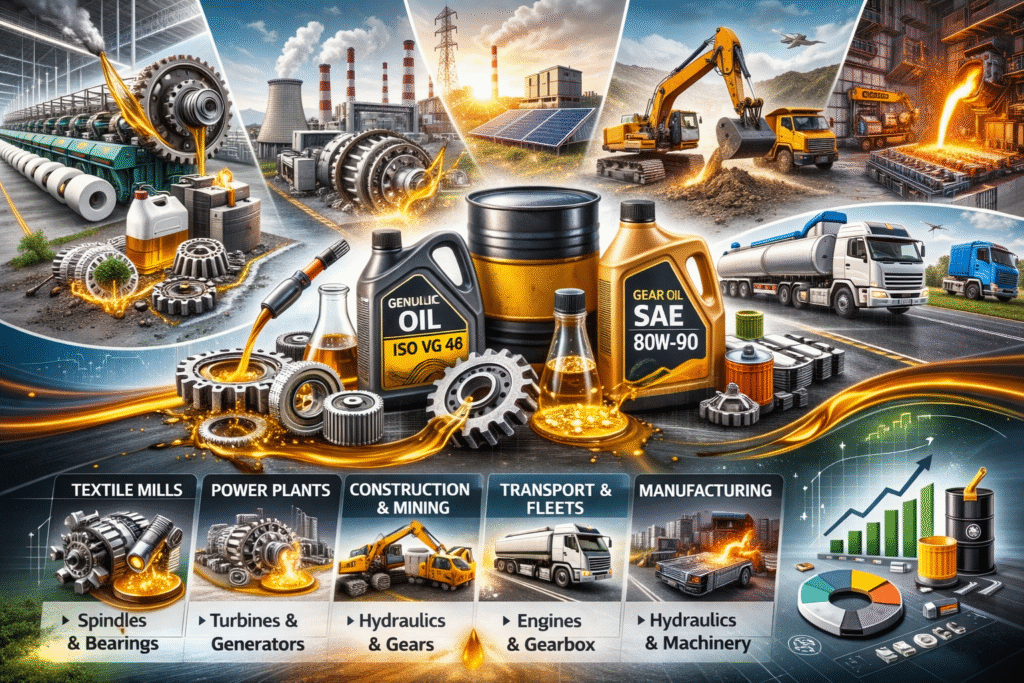
Disclaimer: The images shown are for illustrative and promotional purposes only and represent conceptual industrial lubrication applications across various sectors. Any product grades, specifications, performance figures, or operational scenarios displayed are general industry examples and may vary depending on equipment type, operating conditions, and manufacturer recommendations. These visuals do not represent any specific client, facility, or confirmed performance results, and actual product appearance and specifications may differ.
Best Practice Lubrication Strategy (Across All Sectors)
Scheduled Oil Analysis
Periodic laboratory analysis measures:
- Viscosity
- Contamination (particles, water)
- Oxidation and additive depletion
This enables condition-based maintenance, reducing unnecessary oil changes and minimizing downtime.
Lubrication KPI Tracking
Key metrics include:
- Oil life percentage
- Equipment uptime percentage
- Unscheduled failure rate
Companies that track these metrics outperform competitors in reliability and cost efficiency.
National and Global Statistics
| Metric | Value/Trend |
|---|---|
| Mechanical failures due to lubrication | ~30%¹ |
| Plants adopting condition-based oil analysis | <40%⁵ |
| Gearbox failures prevented by proper oil selection | 25–35% |
Sources:
¹ Machinery Lubrication Journal, 2020
² Textile Efficiency Report, 2021
³ IEEE Power & Energy Society Report, 2019
⁴ ICML Best Practices, 2022
⁵ Global Maintenance Survey, 2023
Conclusion: Lubrication is Maintenance — Not an Expense
Proper oil selection and a strategic lubrication program will:
- Extend equipment life
- Improve reliability
- Reduce operating costs
- Maximize uptime
From textile mills to power generation and heavy-duty fleets, the right lubricants backed by a solid maintenance strategy are essential to business success in Pakistan’s industrial economy.
Need Customized Lubrication Solutions?
Fuel & Lube Pvt Ltd offers:
✔ Equipment-specific lubricant selection
✔ On-site oil analysis
✔ Industry-grade products meeting API, SAE, ISO standards
✔ Technical support tailored to operational needs
Contact our technical team to build a site-specific lubrication program that enhances performance and reduces cost.
Copyright & Rights Notice
© 2026 FUEL & LUBE. All rights reserved.
This article is published for informational and industry analysis purposes only. No part of this publication may be reproduced, distributed, or transmitted in any form or by any means without prior written permission from the publisher.
